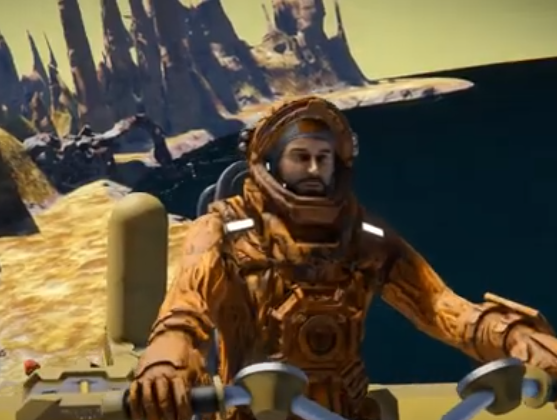
Here is a sneak preview of the opening scene from a new story I started writing recently. It's a sequel to Building Mars and takes place about 22 years afterward. I hope you enjoy reading it as much as I enjoyed writing it!
Hebes Chasma - Mars Year 15 - Earth Year 2055
“Do you ever feel you could get lost
out here, Raf?” murmurs Viv Completa, as she raises herself easily onto the balls of her feet and allows her gaze to wander over the
cliffs that fall from the far side of Hebes Chasma.
It was the middle of the
afternoon during their prescribed break from work, and the shadows among the scree
slopes and spurs still lay meagrely. She was a determinedly fit fifty-three, with
carefully short bronze hair and animated features. She still found it a stretch to
believe that she was living and working on Mars – she’d finally made it, against
all the odds! – even after almost nine Mars years out here.
Raf Vascones barely raised his
head from the e-reader that held his attention. He was in mid-collapse into one
of two sofas which resembled giant marshmallows in shape and colour. “Whadya
mean?” he eventually managed in reply, bouncing gently to a stop. He hadn’t
kept in shape quite as well as he thought he had, his stomach beginning to
strain against his work suit. His Latin good looks, though, made him look much
younger than his fifty years.
One end of her lips curled
upwards at her own thoughts, and her eyes shone. “Well, like, imagine someone
gets dropped into a huge landscape like this. Forced landing maybe, unexpected.
Like there’s no way back home. Like time is suspended and we’re back in the
Early Hesperian. Something like John Carter.” She shook her head and sighed at
the view. In her head she knew that the floor of the massive canyon was
thousands of metres out of sight below, and the furthest slopes lay almost 100
kilometres across the chasma due north, but the clarity and scarcity of the air
made it look like a few hours’ hike. The thousand shades of chocolate cream,
cinnamon and rusty ochre, the way the unnumbered ravines could have been gouged
by huge talons, the elusiveness of the maybe-violet tinge on the horizon and
how it all changed with the Sun’s swinging, despite the million, billion-year
timescale of geological creep: it left her almost speechless every time. But deep
down she caught a glimpse of the still-jagged frustration of that talk with the
SSI committee at Pasteur Base.
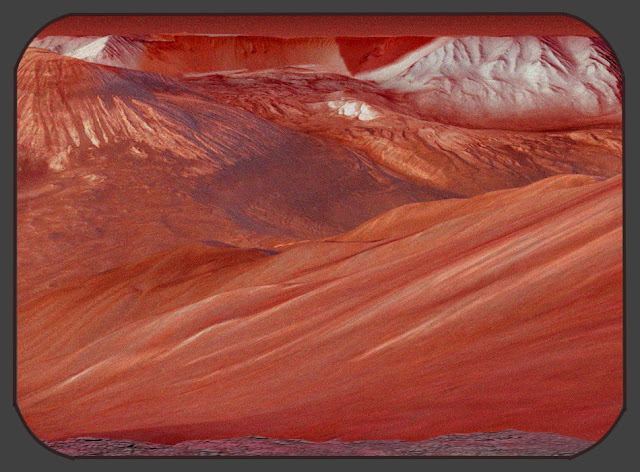 |
| Hebes Chasma, from Google Mars, colours adjusted. |
“Ahh, you still thinkin’ about
the rescue scenario, Viv?”
She chuckled. “Raf, you know me so
well.”
“Urrr… not sure about that.”
He studiously didn’t look up from the quantum computing paper he was reading,
but she’d won a quick, uneasy grin from him. She realised he was uncomfortable
with the implied intimacy. He had earned his reputation as a man with women on
his mind, but she was glad not to be on his must-get list. They worked a lot
together. Perhaps that had something to do with his reluctance.
“Well… maybe I was,” she went on.
“Thinking, that is.” Just now the sun was signalling, probably off some rare faces
of quartz, halfway across the chasma where the mensa’s flat top tailed down eastwards
to the floor. She imagined walking there, picking up billion-year-old shards of
igneous crystal. Instead she spent most of her time inside, fixing battered
rovers and drones and tweaking the life support systems. “You must admit, if
all the bases would cooperate on the essentials, we could all make so
much more progress.”
Raf grunted and shifted on his
sofa. Silence took up the conversation. No – not quite silence. She was aware
of the air circulation like a long-drawn-out sigh, and the distant rumble of
the base’s pumps and waste processors that kept them all alive. There was the arhythmic
ticking of thermal expansion in the structure above the ceiling in the girders
that held up seven metres’ depth of rock and dust. Somewhere back in the base,
further away from the vertiginous cliff face from which the lounge window
peeped, someone started talking in a monologue.
Almost soundlessly, Ellen Hewitson
walked into the lounge and stood behind the long food counter to prepare herself
a meal. Her earbuds were firmly in. Viv could now just make out the whispering
of Ellen’s music, and noticed that she’d cropped her gold-blond hair even shorter
than before. They exchanged nods and smiles. Raf didn’t seem to be paying
attention.
Viv looked out again through the
triple-thick window. The mood in the lounge had shifted, tightening her stomach with
anonymous unease. What was it? Certainly it wasn’t Ellen, with whom she had
always been on easy terms. She couldn’t pin down what had changed. It was
nothing. With a shrug, she whispered to her collar pickup. “Overlay. Profile
cache. Ascendant Corporation, resource claims.” In her eyes the resulting
augment to the view was sharper than her old contact lenses had allowed. Huge
swathes of the landscape were painted in translucent blue hatchings, with
demarcation lines running down the slopes to meet, forming kilometre squares. Textual
details jumped out at her as she focussed on each square. She hadn’t looked at
this in a while, and the extent of the spreading blue alarmed her. She
cancelled the overlay. “Hey, Raf, you know Ascendant’s made more claims? Gotta
be all across the chasma floor now. Didn’t you tell us they were gonna aim more
for Marineris?”
The Argentinian-American
engineer finally gave her his full attention. His dark wave of hair and goatee
could veer towards good looks when he was in a gregarious mood – which was
usually – but now he grimaced. “Firstly, to me they will always be New Space – call
a cobra a rabbit and it will still strike you – and secondly, I still despise
them with all my heart. No doubt they will consume Marineris when it suits
them.” Disturbed, he dropped the e-reader on the sofa and stared out the
window.
Viv could no longer rest in the
lounge. Her bed was calling – there was still a quarter of an hour before the
shift resumed. She stood and made her way around the collection of sofas and coffee
tables to the open door.
The passageway leading to the
atrium first passed by two doorways, the store on the left and the C & C
room on the right. The door to Control & Communications stood open – as usual
– she vaguely recalled that Ellen had been instructing Dawid in the protocols –
and as she passed it she realised that the voice she’d heard in the background
had its source here. Glancing in, she saw no one seated at any of the four crew
positions around the monitors and controls and nobody standing around the datascreen
walls. The voice, insistent and relatively clear despite waves of static, came
from the comms desk. She looked up and down the passageway. Was someone in the
middle of a conversation with Pasteur Base? Apparently not. It was standard procedure
to keep a radio monitoring channel on like this. Who could the speaker be?
She steps into C & C and bends
over the comms desk with its old-school desk microphone, and headphones plugged
into a jack. She very much doesn’t want to be in here when she could be lying
on her bunk listening to something airy by Lacaze or Zubel. Now she can make
out most of the words, floating in a tone that borders on tired irony. …Chasma,
calling all stations, respond please. Unable to roll it back … Rover
Four-Four-Two-Delta, calling…
It sounded more and more like a
distress signal as she listened and her breathing accelerated. Was this the disturbance she’d felt just now? She found herself
in the comms seat, dialing for a little more gain and squelch and flipping the ‘send’ button. “Rover
442 Delta, this is SSI Hebes Chasma base. Receiving you loud and mostly clear.
Please repeat message slowly.” She released ‘send’ and got a grip on her racing
thoughts. Yes. While the distant caller was absorbing her message, she opened the
general base channel and spoke rapidly. “Everyone, we have a radio caller
somewhere in the Chasma, seems to be in difficulties. I’d appreciate company at
C & C. Out.”
She glanced at the intel screen
to her left to find out what identifying code this rover was sending in the
sideband of its signal. Blinking hard twice, she saw there was none, and no APS
location. By this time Rover 442 D was answering in a voice so calm and level
that Viv for a moment felt that this must be some sort of exercise. “SSI
Hebes Chasma, very glad to hear you. We’re in a pretty bad – uh – Situation is
that we rolled the rover, sustained damage, can’t flip it back. Batteries are
low, satcom got crushed against the slope, as did one suitport. The other
suitport’s against the ground. No injuries. Rover frame is buckled but pressure
vessel not, repeat not, compromised. Urgent need rescue, two people only. How soon to our
position, over?”
Ellen and Raf hovered in the
doorway a few moments then came in. Raf stood behind Viv’s left shoulder and Ellen
took the seat opposite her. “Who are they with?” asked Raf. Viv shook her head
and gestured at the intel screen with a shrug. She was the first responder and
SSI protocol was for her to proceed as main contact with the caller.
“442 D, what is your position
please? Coordinates? We’re not getting anything from your sideband.”
The process of dictating and
checking the longitude and latitude took a couple of minutes. Raf jumped into
the seat to Viv’s left and brought up the mapping system. He soon looked up. “Seventy-five
kay roughly east of here, halfway down the slope.” He glanced up at Ellen. By
this time the remaining base crew had entered the room – Dawid, built like a
muscular teddy bear, with cropped black beard and sharp focus; Mei Lin, short
and ballet-lithe, burning nervous energy and self-confidence; and the lone base
areologist Michael Ravindran, grey headed and slightly stooped, perplexed
frown, casting looks left and right. Mei Lin, as the current base commander,
stepped forward, saying, “Viv, please ask how long their oxy reserves and
battery.”
Viv nodded, relayed the question,
learned that they had perhaps three to four hours of oxygen in their reserve.
They couldn’t access the battery monitor. She pushed back a little and looked
around the room. The muscles of her limbs and stomach contract, and it’s like
someone’s opened a freezer door nearby. Stay calm! “So we can make it,
if we leave asap. I volunteer.” Realising exactly what she’s just said, she
pulls a long breath and holds it. This is very sudden. Am I really willing
to stick my neck out for all that talk about crisis response?
Several people started talking
at once. Mei Lin motioned for quiet. She extended a slim finger towards Raf. “Raf,
can we use one of the prospecting copters to bring them oxygen?”
He fingered his short goatee. “Nope,”
he said after a few moments’ thought. “Not nearly enough payload capacity.
Those things are all sensors, right? And the drone rovers are too slow. I think
Viv’s right – “
“OK,” went on Mei Lin, “it’s the
rover, two crew. We start prepping. I’ll take…” and she looked around the room
at each of them.
“Excuse me, Mei,” said Viv, “it
ought to be Raf and I. We’re the mechanics around here, and there are obviously
mechanical issues with this stranded rover.” She grinned. “Sorry to steal all
the fun from the geologists.”
Mei Lin drew a loud breath, the
tension in her short frame palpable, and nodded once, sharply. Again the
finger-point. “Right. Go. We’ll back you up here and prep the second rover.”
Viv turned and flicked ‘send’
one last time. “442 D, SSI Hebes Chasma. We are sending a rover as soon as ready.
Will be with you in…” She looked around at the others, appealing for a quick
estimate. Raf held up three fingers, waved a fourth. Michael shook his head,
raising his eyebrows, and held up two. “We’ll try our best to be there within four
hours,” Viv finished, throwing a quick conciliatory sidelong smile at Michael. “One
more thing – who are you with? New – er – Ascendant?” That was her best guess.
Ascendant rovers and drones were prospecting all over this part of Mars where the science
predicted the most mineral deposits the nearest to the surface.
All six of the base crew hung on
for an answer, one beat, two, three. They needed to know which corporation or
space agency to inform. Then: “SSI, Rover 442, so glad to hear you will be
on your way. Please take care on the slopes. Out.”
“See, I told you…. we need a
rapid response unit! Larger drones with basic supplies, first aid, tools. Faster
rovers, with one always prepped. And spacecraft, or at least sub-orbital
capability, maybe reconditioned landers.” She glanced at Raf as they eased into
the rover’s cockpit to run through the pre-drive checklist. “There – I’ve said
it. That’s all you’ll hear from me on the subject for now.”
Raf grunted an acknowledgement
and started powering up the rover’s life support and comms. “You’re not wrong,”
he said gruffly, “but now is not the time. Hand me that cloth, please.” With the
cloth he wiped condensation from the dashboard and windscreen. Both wore their snug
skinsuits which could quickly be sealed with a helmet in the case of an EVA.
Raf’s suit was patterned with yellow-black bee stripes. Viv’s swirled with
purples and pinks.
Viv ran the diagnostics on the three
axle-mounted motors. They continued, hardly needing the checklist after their
previous experiences of the process. She felt Raf straining to speed up each step, from the speed at which
he rattled off each call-response check, and the way he frowned at nothing in
particular as they had suited up earlier. When they reported their readiness to the base C & C, forty minutes had already passed since Viv had first heard the signal. But finally they could undock the
rear of the rover from the base hatch. “Take care out there,” came Mei
Lin’s voice in their ears. “If there’s any doubt, don’t risk it.”
“Copy, base,” said Raf. Ahead, the
underground parking area was well lit all the way to the gentle ramp that
sloped up to the surface. The long, shallow ramp, lined on either side by orange
LEDs, always made Viv think of a birth canal. Raf had invited her to drive
first. As she engaged the motors and edged the rover forward and onto the ramp,
they could see the glow of sunlight ahead at the mouth of the ramp’s tunnel. She
gripped the wheel as firmly as she dared without letting Raf see the strain in
her knuckles. She’d locked her arms – tried to relax them a little. Please,
please let us be in time! was the thought pounding through her head. “Let’s
go,” said Raf, as though relishing the outing.
Ball of the foot touches the accelerator –
gently! – and the rover begins to race up the ramp, into the dusty light. “Whoa!”
murmured Raf, more out of adrenaline than alarm, she hoped. The gentle sky
glowed the palest orange-grey, laced with a few high cirrus-like strands and
lazy spirals.
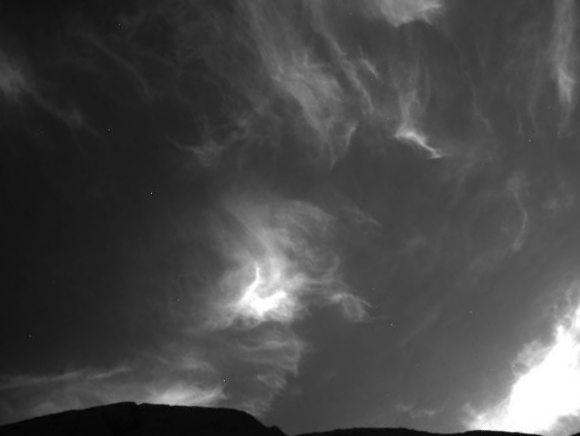 |
| Evening clouds photographed by NASA Curiosity Rover |